Geometry & Symmetry with Fuse Beads
Line symmetry and point reflection are abstract concepts – until children can touch them with beads. Learn how to make mirror properties tangible using pegboards.
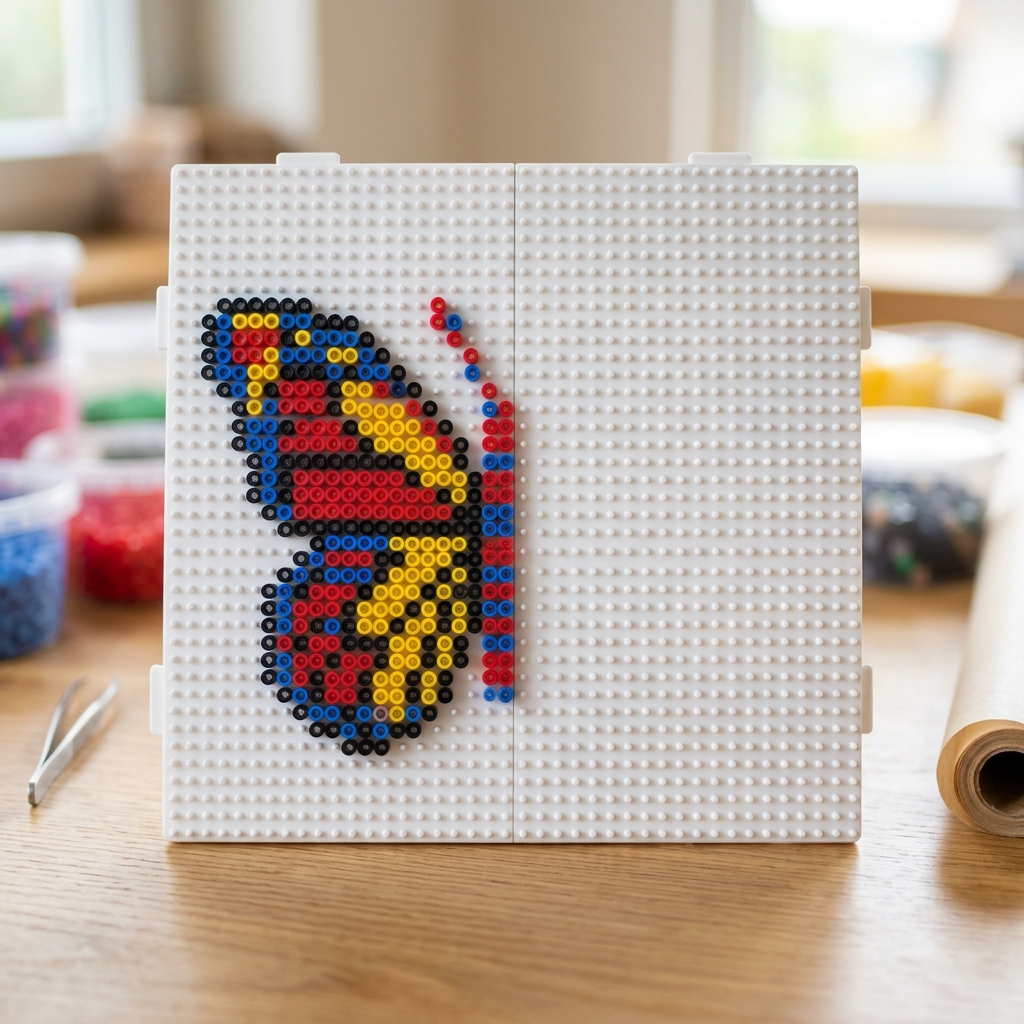
Lesson Idea: The Mirror-Bead Pegboard
The core of the method: The pegboard is divided into two halves using a center line (string, marker, or chalk). Students are given one half and must complete the other half as a mirror image.
Why it works
- Motor skills: Children train fine motor skills and hand-eye coordination.
- Visual-spatial: The concept of "reflection" becomes immediately visually tangible.
- Self-check: Symmetry can be verified with the eyes – no teacher needed.
Learning Objectives for Primary & Special Schools
Grade 1–2
- Recognize and continue patterns
- Simple reflections (vertical)
- Consciously perceive color and shape
Grade 3–4
- Line symmetry (vertical & horizontal)
- Explore rotational symmetry
- Identify geometric shapes
Grade 5–6
- Multiple axes of symmetry
- Point and rotational symmetry (180°)
- Analyze ornaments and patterns
Special Education (Motor Skills)
- Train fine motor skills (grasping, placing)
- Differentiate and name colors
- Train spatial perception
Practical Guides & Worksheets
All materials are designed to be used immediately with simple tools. PDF worksheets contain grid papers for drawing and copying.
📄 Teacher's Guide: Symmetry
Full guide with differentiation, error handling, and tips for special education students.
Download PDF📋 Worksheet: Line Symmetry (Intro)
Simple vertical reflections with large grids (12x12). Ideal for grades 1–2 and special education.
Download PDF📋 Worksheet: Multiple Axes (Advanced)
Combined vertical and horizontal axes of symmetry. For grades 3–4 and advanced students.
Download PDF📋 Worksheet: Rotational Symmetry (Challenge)
Point reflection and 180° rotation. For grades 5–6 and mathematically advanced students.
Download PDF🎨 Worksheet: Designing Ornaments
Students design their own symmetric patterns. Creative and mathematical at the same time.
Download PDF📐 Worksheet: Symmetry Learning Stations
5 differentiated stations for self-paced work. Includes answers for self-checking.
Download PDFTips for Practice
💡 Visualize the mirror line
Use a thin string or a marker to mark the axis of symmetry on the pegboard. This helps children with visual perception difficulties.
🎯 Differentiation: Vary the grid size
Small grids (10x10) for confident students, large grids (15x15 or 20x20) for struggling or special education students. Motor skills should never be the bottleneck.
🪞 The "Mirror Trick" Method
Use a real mirror! If placed upright on the axis of symmetry, the child immediately sees if their pattern is correct. A fascinating "aha" moment.
🎨 Consciously use color
Not all symmetry tasks need to be colorful. Simple black-and-white patterns help struggling students focus on shape and position.